
Why Narcissists Love “Low-Maintenance” Women And Why We Love Animals So Much
By Brenda Stephens, Licensed Professional Clinical Counselor
Why Narcissists Love “Low-Maintenance” Women and Why We Love Animals So Much
In my work with survivors of narcissistic abuse, I hear some version of this all the time:
“I am really low maintenance. I do not need much.”
“I am easy-going. I am fine with whatever.”
“I never wanted to be the center of attention.”
It is rarely said with pride. It is usually said with a little shrug and a lot of history.
On the surface, it sounds like a personality trait. You like to keep things simple. You are not dramatic. You do not want to be “high maintenance.”
Underneath, for many survivors, this “low-maintenance” identity is something very different. It often starts in childhood with a narcissistic or emotionally unavailable parent who made your needs feel dangerous, annoying, or invisible. The safest way to exist was to take up as little space as possible.
Over tim,e that survival role hardens into an identity. You stop thinking, “I learned to need less to stay safe,” and start thinking, “I just am someone who does not need much.”
I call this pattern the Low Maintenance Script.
In this post, I want to walk you through:
-
How narcissistic parents train children to be “easy.”
-
What echoism is and why it matters
-
How does that become an adult, low-maintenance identity
-
Why are narcissistic partners so attracted to this
-
How love for animals often fits into this pattern
-
What it looks like to start changing the script
If you recognize yourself in this, you are not broken. You are patterned. That can change.
How Narcissistic Parents Train You To Shrink
A narcissistic parent does not relate to you as a separate person with your own inner world. You become:
-
A reflection of them
-
A caretaker for their emotions
-
A prop in their image
-
A rival if you shine too brightly
Their moods are the weather in the house. You learn very early that your survival depends on reading the weather and adjusting yourself.
You may have grown up with rules that were never spoken out loud, but you felt them in your body:
-
“If I have needs, someone will explode, sulk, or withdraw.”
-
“If I am too happy or successful, someone will cut me down.”
-
“If I complain, I am ungrateful or dramatic.”
On top of that, many narcissistic parents complain endlessly about “needy” people while praising anyone who is “low maintenance.” You hear things like:
-
“Your sister is so sensitive. You are the easy one.”
-
“I love that you do not need much from me.”
-
“You are not like those people who are always whining.”
So you adapted. Children always do. You learned to:
-
Smile when you were hurt
-
Say “I am fine” when you are not.
-
Anticipate other people’s needs before they say anything.
-
Make yourself very easy to be around.
You were not born low maintenance. You were trained to be low impact.
This is not a personality trait. It is a survival strategy that your nervous system coded in as “how to stay safe and loved in this house.”
What Is Echoism?
There is a name that fits many survivors of narcissistic parents. It is called echoism.
If narcissism is an extreme focus on the self, echoism is the learned habit of erasing the self.
Echoism can look like:
-
Feeling guilty when you have needs
-
Worrying that speaking up makes you selfish
-
Turning attention away from yourself as fast as possible
-
Feeling more comfortable caring for others than being cared for
-
Struggling to answer simple questions like “What do you want?”
Echoism often grows in homes where one person takes up all the emotional space. The child learns, “There is only room for one big personality here, and it is not me.”
In narcissistic families, the parents’ needs, moods, and image run the whole show. The child becomes the supporting cast. If you tried to assert yourself, you were ignored, mocked, or punished. If you faded into the background and stayed “easy,” you were more acceptable.
Now add in “good girl” conditioning:
-
“You are so easy.”
-
“You never cause trouble.”
-
“You are not like other girls.”
-
“You are so mature.”
You get praised for being low-key, undemanding, and accommodating. You get punished or shamed when you show anger, grief, jealousy, or strong preferences.
Over time, your nervous system records a simple rule:
“I am safest and most acceptable when I stay small and need very little.”
That rule is the foundation of the Low-Maintenance Script.
How Echoism Becomes A “Low Maintenance” Identity
Fast forward into adulthood. You may genuinely believe:
“I just do not need much.”
“I am go-with-the-flow.”
“I am not like people who always want attention.”
You might even joke that you were “the easy kid” and now you are “the easy partner.” It feels like a stable part of your personality. It does not always register as something installed in you over the years of managing a difficult parent.
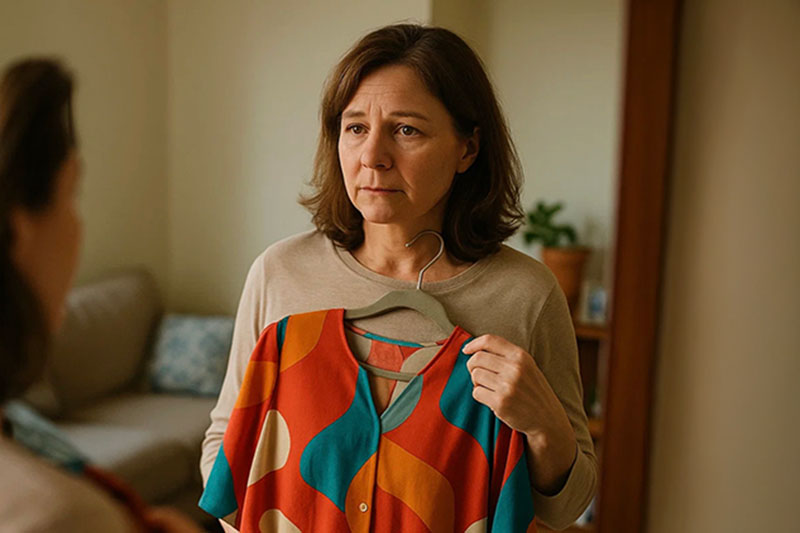
This is not about clothes or makeup. This is about how you treat your own needs, feelings, and presence.
It can show up in a few areas.
1. Appearance and visibility
You may:
-
Avoid clothes or makeup that draws attention.
-
Downplay your looks so no one feels threatened.
-
Tell yourself you “just prefer” staying in the background.
Many narcissistic parents react badly when their child shines. They may compete with you, criticize you, or accuse you of being vain. Your system learns that visibility is dangerous.
There is nothing wrong with a simple style. The question is whether it feels like freedom or safety.
If the idea of being more visible makes you feel exposed, guilty, or “too much,” that is not just a matter of taste. That is your nervous system remembering what happened when you stood out.
2. Emotional needs
You might:
-
Apologize for asking for help.
-
Feel like “too much” when you are sad or overwhelmed.
-
Talk yourself out of your own hurt with “other people have it worse.”
-
Tell friends or partners, “It is no big deal,” even when it is.
In a narcissistic household, your feelings may have been treated as an inconvenience or an attack. You were told you were dramatic, sensitive, or selfish if you needed comfort.
So you learned to get ahead of the criticism by shrinking your needs before anyone else could.
You are not low maintenance here. You are self-silencing.
3. Conflict and preferences
In relationships and friendships, you may:
-
Say “whatever you want” so often that you stop knowing what you like
-
Avoid bringing up issues to avoid “starting something.”
-
Feel responsible for keeping the peace at all costs.
-
Stay quiet when you are disrespected, then turn the anger inward.
As a child, conflict probably never felt fair or safe. The narcissistic parent had to win. They rewrote history, shifted blame, or exploded until you backed down.
So, as an adult, your body still treats conflict as something you will not survive intact.
On the outside, people may describe you as “easygoing” or “chill.”
On the inside, you carry the cost of never really landing in your own life.
Why Narcissistic Partners Are So Attracted To This Pattern
Here is the painful part. The Low-Maintenance Script that helped you survive your childhood often sets you up for adult relationships with narcissistic partners.
Narcissistic partners look for certain qualities, even if they would never say it out loud. They tend to be drawn to people who:
-
Will put their needs first
-
Will regulate their moods for them
-
Will admire them and make them feel special
-
Will not demand true reciprocity
If you grew up with a narcissistic parent, your nervous system already knows how to do this dance. You know how to read the room, stabilize someone else, and apologize to keep things calm.
Your echoism and low-maintenance identity can feel like the perfect match for their narcissism.
From their point of view, you are:
-
Easy to impress
-
Willing to explain away bad behavior
-
Quick to take the blame
-
Slow to set limits
When a narcissistic partner love bombs you, your system lights up. Finally, someone is choosing you. Finally, you do not have to work so hard for crumbs.
When they start to devalue you, your first move is often self-blame:
“I must have done something wrong.”
“I should be more patient.”
“Maybe I am asking for too much.”
In other words, you slip right back into the child role. You shrink, silence yourself, and work to “fix it” so the other person does not leave.
This is precisely why so many low-maintenance survivors say to me:
“I do not even like attention. How did I end up with someone who had to be the star all the time?”
You did not lose a competition. There was no contest. You were conditioned to move around other people and make room for them. A narcissistic partner stepped into that space.
Why You May Feel Safer With Animals Than With People
Many low-maintenance survivors tell me that animals are their favorite beings on the planet.
They will say things like:
“I would rather be with my dog than any person I know.”
“I take better care of my pets than I do of myself.”
“Animals are so easy. They love you.”
This is not an accident. It fits the pattern.
For someone who grew up with a narcissistic parent:
-
Animals feel emotionally honest. They are not pretending, stonewalling, or spinning a story about why you are the problem.
-
Animals receive care without criticizing you. You can pour love, food, and attention into them, and no one tells you that you are needy or dramatic.
-
Animals let you be needed safely. You get to be the reliable one, but this time the relationship won’t collapse if you have a feeling or need a break.
Often, the same woman who says she is “low maintenance” with people will quietly arrange her whole day around the needs of the dog, the cat, the foster animals, and the birds she feeds outside.
She is not low maintenance at all when it comes to giving. She is generous, tuned in, and intensely loyal. She just learned that it was safer to direct that care toward beings who would not shame or punish her.
Loving animals is not a problem. In many ways, it is one of the healthiest instincts you have. The risk is that you use it as more proof that:
“I am fine. I do not need anything back.”
The truth is, you deserve relationships with humans that feel at least as safe as your bond with your pets. Your nervous system already knows how to connect. It learned that with animals first because they felt safer than people. Healing includes letting some of that warmth and loyalty return to you.
The Hidden Cost Of Being “Easy”
The culture often praises low-maintenance women. You hear:
“She is so chill.”
“She is not like other women.”
“She is not demanding at all.”
The cost is invisible from the outside, but your body feels it.
The Low Maintenance Script can show up as:
-
Depression that looks like numbness or “I do not care anymore.”
-
Anxiety every time you consider asking for what you need.
-
Resentment that you swallow because you feel guilty for having it.
-
Physical symptoms from chronic stress and self-suppression.
You may even find yourself judging women who are more direct about their needs, while secretly wishing you felt that free.
Please hear this clearly:
You are not weak for being low-maintenance. You were trained. You kept the peace in a family system that punished you for having a self. That took skill and intelligence. It also came at your expense.
What It Looks Like To Start Changing The Script
You do not have to swing to the other extreme and become someone you are not.
Healing is not about forcing yourself into a different role. It is about letting your authentic self step out from the script you were handed.
Here are some places where work often begins.
1. Getting curious about your “I am fine.”
Start noticing the reflexes you developed:
-
How fast do you say “I am fine” or “It is ok” even when you are hurt?
-
How often do you say “I do not care, whatever you want” when you actually do care?
You do not have to change it yet. Just notice that this is the script speaking, shaped by a childhood with very little room for your inner world, not the whole of you.
2. Naming your wants in low-stakes moments
Practice saying what you want in small, everyday situations:
“I would actually rather stay in tonight.”
“I like that restaurant less than the other one.”
“I need a quiet morning.”
Your nervous system will feel exposed at first. That does not mean you are doing something wrong. It means you are doing something new.
Each small act of honesty is a tiny repair to the part of you that learned, as a child, that wanting anything was risky.
3. Treating your needs as information, not a problem
When you feel lonely, tired, frustrated, or overwhelmed, try trading in the old scripts:
From “I am too much.”
to “Something in me needs attention.”
From “I should be able to handle this.”
to “Of course I feel this way. What would support look like?”
You are not becoming high maintenance. You are becoming honest.
4. Watching who stays and who leaves
As you begin to take up a little more space:
-
Healthy people may be surprised, but they adjust.
-
Narcissistic or controlling people often get angry, punish you, or pull away.
That is painful, but it is also obvious data. You finally see who loved you as a person and who loved you because you were convenient.
If you saw yourself in this, you are not alone. Many survivors of narcissistic parents carry the Low-Maintenance Script for decades and think it is just”“who they are””
It is not. It is what you had to be.
You are allowed to:
-
Have preferences
-
Take up space
-
Be visible
-
Disagree
-
Ask for repair
-
Want care that goes both ways
None of this makes you selfish, this is normal!
Next Steps And Support
If this stirs something in you and you are tired of performing”“eas”” while you are exhausted inside, this is exactly the kind of work I do.
As a therapist who specializes in narcissistic abuse recovery, I help survivors:
-
Understand how their history shaped this low-maintenance identity
-
Unhook from echoism and chronic people pleasing
-
Learn how to set limits without drowning in guilt
-
Build relationships where their needs are not a liability
You do not have to untangle this alone or guess your way through it.
If you are ready to start shifting out of the Low-Maintenance Script, you can learn more about therapy and coaching with me through narctrauma.com or reach out directly for support.
You have carried otherpeople’ss comfort long enough. It is not selfish to start caring about your own.
If this spoke to you
We specialize in working with survivors of narcissistic abuse, especially women who grew up with narcissistic or emotionally immature parents and find themselves repeating painful patterns in love.
You can learn more or connect with me through narctrauma.com, and you can listen to more conversations like this on my podcast”“Two Queens and a Joker: MyNarcissist’ss Ex and Me””
If you want support that understands narcissistic systems and the specific pain of narcissistic abuse, you can:
-
Work with us
Ready to start healing? Book an appointment or join a group.
Therapy, groups, and intensives
Contact & waitlist -
Trauma Toolbox app
Guided grounding, micro-practices, body resets, and crisis-calming audio in under five minutes.
Get the app -
Podcast: Two Queens and a Joker: MyNarcissist’ss Ex and Me
Real talk about recovery, parenting, and rebuilding a life you actually want.
Listen on YouTube
Listen on Spotify
Listen on Apple Podcasts